
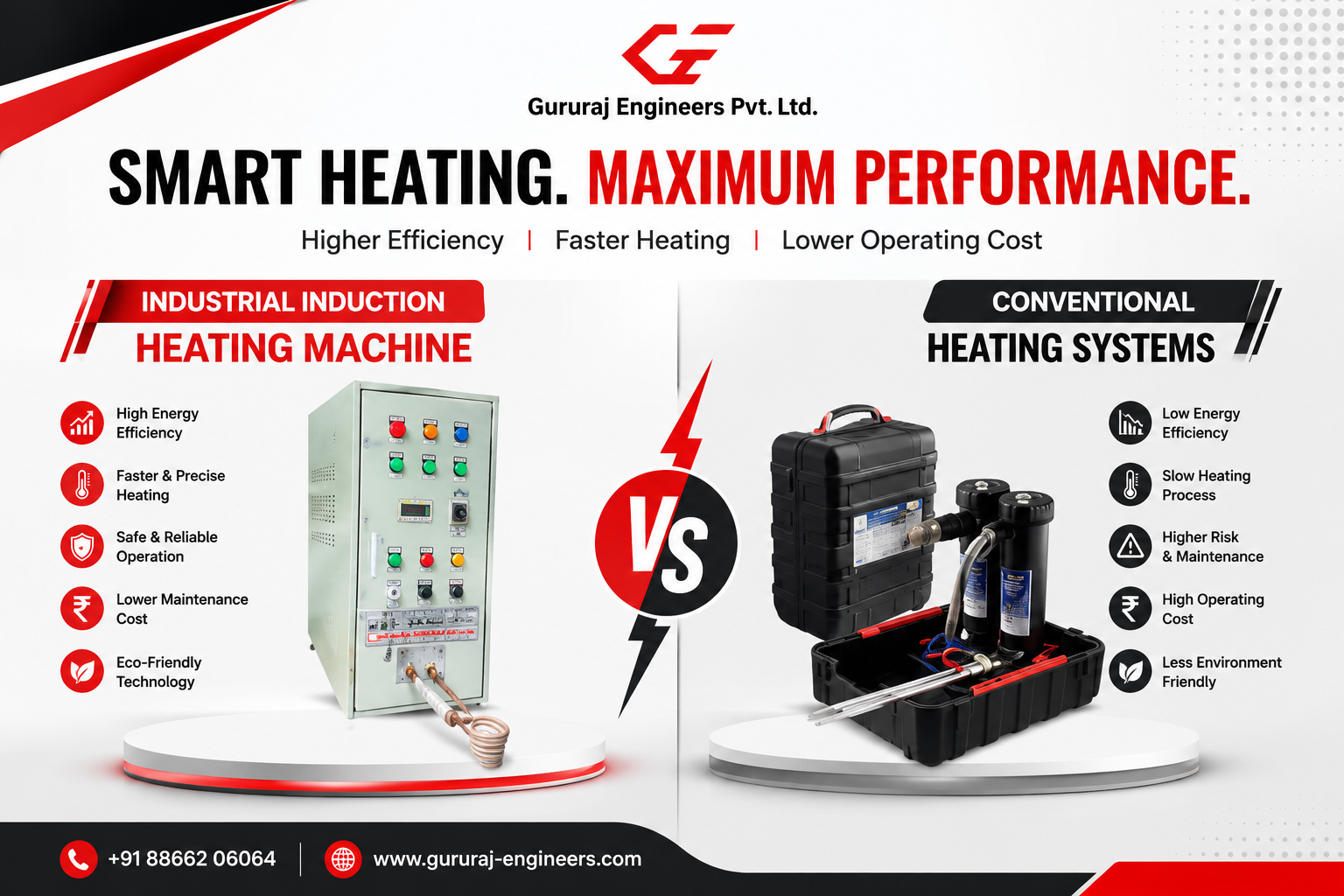
Industrial Induction Heating Machine vs Conventional Heating Systems
Manufacturers today are under constant pressure to improve ivity, reduce energy consumption, and maintain consistent quality. Choosing the right heating technology plays a significant role in achieving these goals. An induction heating machine offers rapid, precise, and energy-efficient heating, making it an increasingly popular alternative to conventional heating systems.
As a trusted manufacturer of advanced industrial heating equipment, Gururaj Engineers provides reliable induction heating solutions designed to enhance ion efficiency, reduce operational costs, and deliver consistent heating performance across a wide range of industries.
What Is an Induction Heating Machine?
An induction heating machine uses electromagnetic induction to generate heat directly within a conductive metal workpiece, providing fast, localized, and highly controlled heating without direct contact or open flames.
Unlike conventional heating methods that transfer heat from an external source, induction heating generates heat internally. This minimizes energy loss and significantly reduces heating time while improving temperature accuracy.
Industries such as automotive, forging, aerospace, heavy engineering, metal fabrication, and manufacturing rely on induction heating for applications requiring precision and repeatability.
What Are Conventional Heating Systems?
Conventional heating systems generate heat using combustion, electrical resistance, gas burners, furnaces, ovens, or radiant heaters. Heat is transferred from the heating element to the surrounding air and then to the workpiece.
While these systems remain suitable for certain applications, they often require longer heating cycles, consume more energy, and provide less precise temperature control compared to induction technology.
Induction Heating Machine vs Conventional Heating Systems
Although both technologies perform the same fundamental task—heating materials—their efficiency and operating principles differ significantly.
| Feature | Induction Heating Machine | Conventional Heating System |
|---|---|---|
| Heating Speed | Extremely Fast | Slow to Moderate |
| Energy Efficiency | High | Moderate to Low |
| Heat Accuracy | Very Precise | Less Accurate |
| Process Control | Excellent | Limited |
| Heat Distribution | Localized | Entire Component |
| Operating Cost | Lower Over Time | Higher Energy Consumption |
| Maintenance | Low | Moderate to High |
| Workplace Safety | High | Lower due to open heat sources |
Why Is an Induction Heating Machine More Energy Efficient?
One of the biggest advantages of an induction heating machine is its exceptional energy efficiency.
Because heat is generated directly inside the metal, very little energy is wasted heating surrounding air, fixtures, or equipment. Conventional systems lose considerable energy during heat transfer, resulting in higher electricity or fuel consumption.
Businesses looking to reduce operating expenses often recover their investment through lower energy bills and improved ion output.
How Does Faster Heating Improve Productivity?
Production efficiency depends heavily on reducing cycle times.
An induction heating system can reach the required temperature within seconds or minutes, while traditional furnaces may require significantly longer warm-up and heating periods.
Faster heating offers several operational benefits:
- Higher ion capacity
- Reduced idle machine time
- Shorter manufacturing cycles
- Increased throughput
- Improved equipment utilization
For industries handling continuous ion, these improvements directly impact profitability.
Why Is Process Control Better with Induction Heating?
Precise temperature control is essential for maintaining consistent quality.
An automated heating process allows manufacturers to monitor and control heating parameters such as temperature, time, power output, and heating cycles with exceptional accuracy.
This minimizes:
- Material distortion
- Surface oxidation
- Overheating
- Product rejection
- Rework costs
Automation also reduces dependence on manual intervention, improving consistency across ion batches.
Applications of Induction Heating Machines
Modern industrial heating equipment is used across numerous manufacturing processes.
Common applications include:
Heat Treatment
Induction heating is widely used for hardening, tempering, annealing, and stress relieving metal components.
Brazing and Soldering
Localized heating allows clean, reliable joining without affecting surrounding materials.
Forging
Induction systems heat metal billets quickly before forging, reducing ion time and improving energy efficiency.
Shrink Fitting
Controlled heating expands metal components for accurate assembly without damaging parts.
Melting
Induction furnaces efficiently melt various metals while maintaining precise temperature control.
How Does a Coil Heating Machine Work?
A coil heating machine uses specially designed induction coils that generate a magnetic field when electrical current passes through them.
When a conductive metal component is placed within this magnetic field, eddy currents develop inside the workpiece, generating heat internally.
Different coil designs are available depending on:
- Component shape
- Material type
- Heating depth
- Production speed
- Process requirements
Proper coil design plays a major role in achieving efficient and uniform heating.
Advantages of an Automated Heating Process
Manufacturers increasingly adopt automation to improve ivity and quality.
An automated heating process offers several operational advantages:
- Consistent heating quality
- Reduced operator dependency
- Higher ion speed
- Real-time monitoring
- Lower human error
- Better repeatability
- Improved quality
- Easy integration with ion lines
Automation also supports Industry 4.0 manufacturing by enabling digital monitoring and process optimization.
Buyer Considerations Before Choosing an Induction Heating Machine
Selecting the right equipment requires evaluating both current ion needs and future expansion plans.
Consider the following factors:
Material Compatibility
Different metals respond differently to induction heating. Ensure the machine matches your application.
Production Volume
High-volume manufacturing benefits significantly from fast heating cycles and automation.
Power Capacity
Choose equipment capable of delivering sufficient heating power without unnecessary energy consumption.
Coil Design
Proper induction coil design improves heating efficiency and ensures uniform temperature distribution.
Automation Requirements
Determine whether your ion line requires programmable controls, robotic integration, or automated loading systems.
After-Sales Support
Reliable technical support, spare parts availability, and maintenance services contribute to long-term operational efficiency.
Common Mistakes to Avoid
Many manufacturers focus solely on machine price instead of long-term operating performance.
Common mistakes include:
- Selecting incorrect power ratings
- Ignoring future ion expansion
- Using unsuitable induction coils
- Overlooking cooling system requirements
- Choosing equipment without automation capability
- Purchasing from inexperienced suppliers
Working with an experienced manufacturer helps avoid costly ion challenges.
Why Choose Gururaj Engineers?
Gururaj Engineers specializes in manufacturing advanced induction heating machines engineered for performance, precision, and long-term reliability.
Customers benefit from:
- Customized heating solutions
- Robust machine construction
- High energy efficiency
- Advanced automation capabilities
- Precision temperature control
- Reliable technical support
- Industry expertise across multiple manufacturing sectors
- Quality-focused engineering
Whether your application involves heat treatment, forging, brazing, melting, or shrink fitting, Gururaj Engineers delivers dependable solutions tailored to your ion requirements.
Conclusion
Choosing the right induction heating machine can significantly improve manufacturing efficiency, reduce energy consumption, and enhance quality. Compared with traditional heating methods, induction technology provides faster heating, superior process control, lower operating costs, and greater ion consistency.
For manufacturers seeking reliable industrial heating equipment that supports modern automation and precision manufacturing, partnering with an experienced company like Gururaj Engineers ensures long-term performance and operational success.
FAQs
1. What is an induction heating machine used for?
An induction heating machine is used for heat treatment, forging, brazing, annealing, shrink fitting, melting, soldering, and other industrial metal heating applications requiring precise and efficient temperature control.
2. Is induction heating more energy efficient than conventional heating?
Yes. Induction heating generates heat directly within the metal, reducing heat loss and significantly improving energy efficiency compared to traditional furnaces and resistance heating systems.
3. Which industries benefit most from induction heating machines?
Automotive, aerospace, heavy engineering, steel processing, metal fabrication, foundries, tool manufacturing, and machinery ion industries commonly use induction heating technology.
4. How does an automated heating process improve manufacturing?
Automation ensures consistent heating cycles, improves quality, reduces manual errors, increases ion speed, and enables real-time process monitoring.
5. How do I choose the right induction heating machine?
Consider factors such as material type, ion volume, power capacity, coil design, automation requirements, cooling systems, and the manufacturer's technical expertise before making a decision
Read more:-How Industrial Induction Heaters Improve Metal Processing Efficiency.

