Call Our Technical Team

About Us
Contrary to popular belief, Lorem Ipsum is not simply random text. It has roots in a piece of classical Latin literature from 45 BC, making it over 2000 years old.
Contrary to popular belief, Lorem Ipsum is not simply random text. It has roots in a piece of classical Latin literature from 45 BC, making it over 2000 years old.
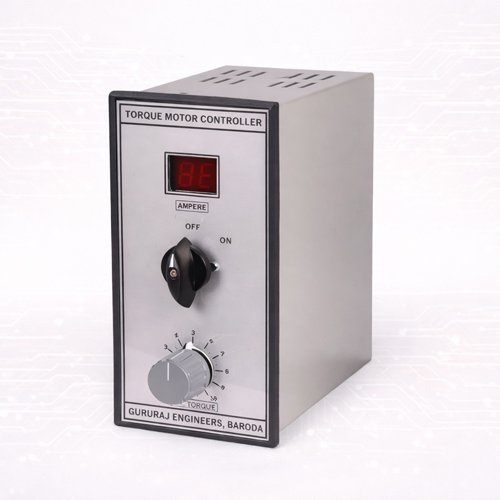
A PWM DC motor controller does not exist for adjustment alone. It defines how a motor responds when demand changes. In automated production lines, conveyors, packaging systems, and machine tools, uncontrolled speed leads to process instability and mechanical stress. Pulse Width Modulation regulates voltage through controlled switching cycles instead of resistive dissipation. Power reaches the motor in measured intervals. Torque output remains consistent. Energy loss stays limited. When modulation accuracy weakens, vibration increases, temperature rises, and component wear accelerates. A correctly engineered controller maintains smooth acceleration, controlled rotation, etc. Equipment life and operational reliability depend on this level of control.
Gururaj Engineers Pvt Ltd develops controllers with practical industrial conditions. As established PWM DC Motor Controller Manufacturers in Vadodara, we focus on electrical accuracy, load adaptability, and structural durability. Circuit configuration is designed to maintain stability under varying operational demand. Heat dissipation is addressed at the design stage. Switching balance is maintained. Protection mechanisms are integrated to prevent overload damage. Each controller is assembled according to defined electrical specifications, ensuring dependable function in continuous industrial use.
Operating as PWM DC Motor Controller Suppliers in Gujarat, we provide controllers suited for varied industrial applications, including:
Application specific voltage and current configuration.
Stable motor speed under variable load conditions.
Compact design suitable for industrial control panels.
Energy smooth operation with less electrical loss.
We are also referred to one of the leading PWM DC Motor Controller Exporters from India. Exported controllers that meet international performance and safety standards. We test them before dispatch. Electrical parameters are verified. Shipment preparation ensures the controller integrates directly into existing drive systems. Whether installed in new machinery or replacing older control units, the objective remains unchanged—accurate motor control, stable performance, and durability aligned with industrial operating demands


Looking for Industrial Induction Heater, DC Speed Controller, SCR Power Controller, AC/DC Load Bank or High Power DC Supply? Our expert engineering team provides customized, energy-efficient and reliable industrial solutions tailored to your requirements.
Call Our Technical Team

